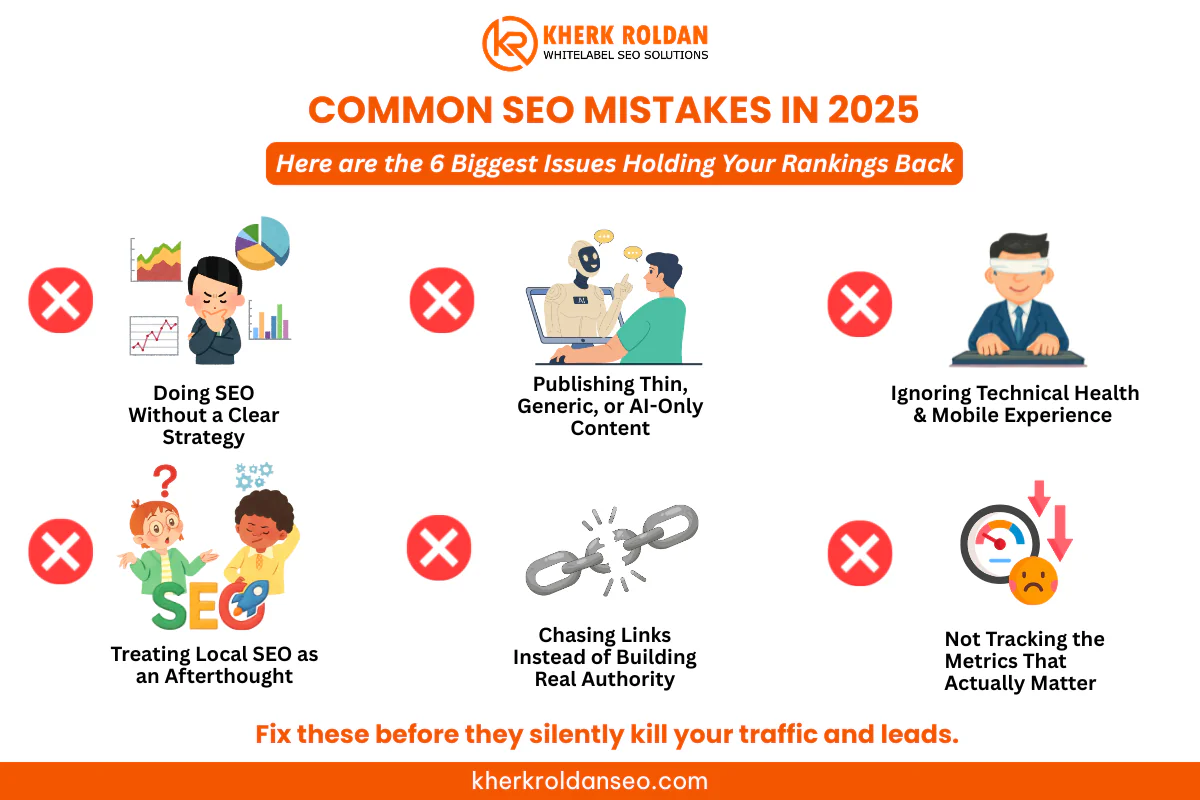
If you feel like you “do SEO” but nothing really moves, there is a big chance that a few common SEO mistakes are quietly killing your results.
This guide shows what those mistakes look like in 2025, how they cost you money, and what you can do today to fix them.
Why Common SEO Mistakes Hurt More in 2025
SEO used to be simple: rank higher, get clicks, get leads.
Today, things have changed:
- Searchers see AI Overviews, featured snippets, and map results before your website.
- Around 75% of users never go past the first page.
- 52% of sources in Google’s AI Overviews come from the top 10 results, so if your pages have basic mistakes, AI also skips you.
On top of that, similarweb data shows more “zero-click” searches since AI Overviews rolled out, meaning people often get their answer without ever visiting a site.
In simple terms:
If your SEO is weak, you not only lose rankings but also traffic.
You disappear from Google, Maps, and AI answers at the same time.
Mistake #1: Doing SEO Without a Clear Strategy
Many companies start with “blogs and backlinks” without a plan.
Common signs:
- No clear priority keywords or topics
- Multiple pages targeting the same keyword (cannibalization)
- Content that does not match what people really search for
- No link between keywords and actual leads or sales
Yet in 2023, 39% of marketers said working on on-page content and keywords was their main SEO tactic, which shows how important clear keyword focus still is.
How to fix this
- Define your core goals
- Local service calls?
- E-commerce sales?
- B2B demo bookings?
- Map keywords to pages
- One main keyword + supporting terms per page
- For example, a service page for “roofing contractor in Dallas” and another for “metal roof replacement in Dallas,” rather than mixing both.
- Cover intent properly
- “What is…” → educational blog
- “Best [service] near me” → local service page + Google Business Profile
- “Price/cost” → pricing or packages page
- Remove cannibalization
- Merge weak, overlapping blogs into one strong guide
- Redirect old duplicate pages to the main page
This is the base for everything else. Without it, even the best content and links struggle.
Mistake #2: Thin, Generic, or AI-Only Content
In 2025, thin, copy-paste, or AI-only content does not stand a chance.
Search engines and AI assistants want:
- Depth
- Clear answers
- Real experience and proof
Studies show that longer, in-depth content (3,000+ words) often brings 3x more traffic and 3.5x more backlinks than average-length content.
If your pages are short, generic, or simply rephrased from competitors, AI tools and search engines see no reason to feature them.
How this looks in real life
- Blog posts that repeat the same points everyone else says
- Service pages with 200–300 words and no FAQs, reviews, or examples
- AI-written articles with no local context, pricing hints, or process details
How to fix this
Think in topical coverage, not just individual keywords:
- Start with a real outline
- Answer the main question
- Add “People Also Ask” topics
- Include process, pricing ranges, timelines, and mistakes
- Add real-world proof
- Screenshots of results
- Before/after stories
- Client quotes (even short ones)
- Blend AI with human editing
- Use AI as a helper for structure and draft ideas
- Add your own examples, local notes, and case studies
- Check tone and accuracy before publishing
Mistake #3: Ignoring Technical Health and Mobile Experience
You can write the best content, but if your site is:
- Slow
- Hard to navigate
- Broken on mobile
Your rankings and conversions will suffer.
In HubSpot’s State of Marketing data, 80% of Gen Z and 62% of millennials primarily use mobile search, which means a bad mobile experience kills a big part of your audience.
Typical technical SEO mistakes
- No HTTPS or mixed content warnings
- Slow pages due to heavy images or scripts
- Broken internal links and 404 errors
- Missing basic tags like title, meta description, and headings
- No proper XML sitemap or robots rules
How to fix this
- Run a technical audit (Google Search Console, PageSpeed tools, or a full SEO audit service).
- Compress images and use modern formats.
- Clean up broken links and old redirects.
- Make sure important pages are easy to reach in 3 clicks or fewer.
- Mobile test and adjust layouts, fonts, and buttons.
For many clients, simply resolving technical issues has led to better indexation and higher visibility, even before new content was added.
Mistake #4: Treating Local SEO as an Afterthought
If you run a local or service-area business (like an electrician, plumber, clinic, med spa, or detailing shop), skipping local SEO is a costly mistake.
Some key numbers:
- In 2022, 87% of consumers researched local businesses on Google Search, and 98% read online reviews of local brands.
- Local studies show Google Business Profiles can drive about 100+ website visits and around 200 interactions (calls, directions, clicks) per month when they are active and well-maintained.
If your GBP is half-empty, has weak categories, or old photos, you are leaving money on the table.
Common local SEO mistakes
- Wrong primary category in Google Business Profile
- Inconsistent name, address, phone, or hours
- No local photos, no posts, no Q&A
- Few or no reviews, or reviews that do not mention your key services and locations
- No dedicated city/suburb pages on your site
How to fix this
- Choose the right primary category and strong secondary categories.
- Keep NAP (name, address, phone) and hours consistent everywhere.
- Ask happy customers for reviews that mention service + location.
- Add monthly posts, Q&A, and geotagged photos.
- Build focused location pages (e.g., “Roofing Company in Dallas, TX”) with FAQs and testimonials.
For Philippine- and Asia-based businesses, this is even more important, as many people rely on Maps and reviews before sending a message or calling.
Mistake #5: Chasing Links Instead of Building Authority
Links still matter.
But random link packages and spammy tactics can do more harm than good.
A 2025 meta-analysis on SEO in digital marketing found that SEO improves visibility and conversions when strategies focus on relevance and quality rather than raw link volume.
Risky link habits
- Buying bulk “backlink blasts.”
- Comment spam and low-quality directories
- Links from unrelated sites or shady networks
- Anchor text that repeats the same keyword
These might trigger short-term movement, followed by sudden drops or manual actions.
How to fix this
Think of links as proof of trust, not just numbers:
- Get featured in relevant blogs or industry sites.
- Publish case studies and let partners link back to them.
- Use guest posts on real websites with real audiences.
- Make sure your own content is worth citing so AI tools and authors pick it up.
Mistake #6: Not Measuring What Matters
Another widespread SEO mistake to avoid is running a campaign without precise tracking.
Many companies only look at:
- “Traffic went up.”
- “Some keywords moved.”
But ignore:
- Leads or sales from organic traffic
- Form submissions, calls, and booked appointments
- Lifetime value of SEO clients
How to fix this
- Set up basic tracking
- Google Analytics (events and goals)
- Google Search Console (queries, pages, CTR)
- Call tracking or tagged phone numbers if possible
- Watch these simple KPIs monthly
- Total organic clicks and impressions
- Average position for your top 10–20 keywords
- Leads from organic (forms, calls, bookings)
- Review and adjust
- Double down on pages that bring leads
- Refresh content that is slipping in rankings
- Fix pages with traffic but low conversions (better offers, clearer CTAs)
In 2025, one Australian tradie paid nearly $20,000 AUD for SEO and a website and got only four visits per month and zero leads, mostly because there was no clear strategy, tracking, or adjustment.
You never want that to be your story.
How to Avoid SEO Mistakes in 2025: A Simple Framework
To make this practical, think of your SEO as four pillars:
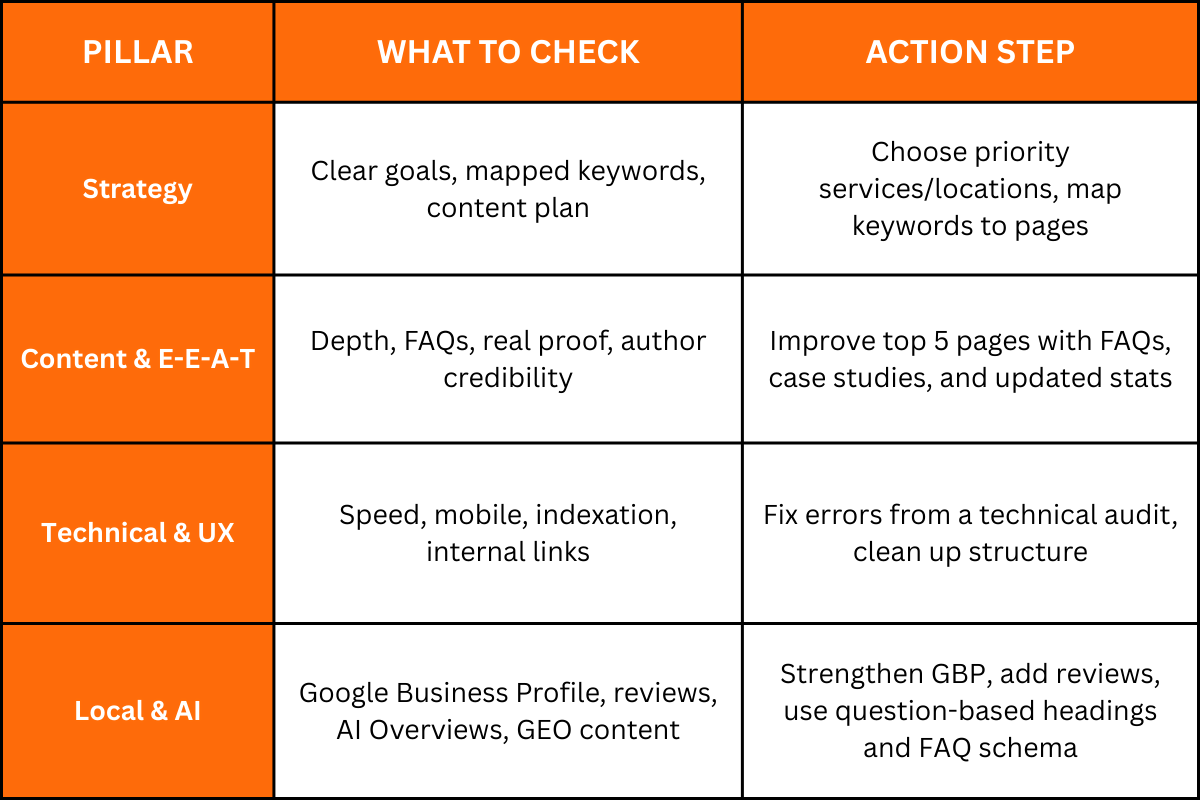
When these four areas are in place, you avoid most of the SEO mistakes to avoid in 2025 and give your business a real chance to win in search and AI.
FAQs
- What are the most common SEO mistakes businesses make?
The big ones include: no clear keyword and content strategy, thin or generic content, ignoring technical health and mobile experience, weak local SEO, risky link tactics, and no tracking of leads from organic traffic. Fixing these six areas usually brings the fastest wins. - How do you fix SEO mistakes on a website?
Start with an audit: strategy, content, technical, local, and links.
Prioritize quick wins (fix broken pages, improve top-traffic content, clean up your Google Business Profile), then work on deeper content and authority building. If this feels heavy, a done-for-you SEO service can handle the technical work while you focus on operations. - What is the biggest mistake in SEO in 2025?
The biggest mistake is treating SEO as “just rankings” and ignoring visibility in AI, maps, and multi-platform search. Your brand has to show up not only in blue links but also in AI Overviews, chat answers, Maps, and other platforms. That only happens when your strategy, content, and technical setup are solid. - How long does it take to recover from SEO mistakes?
For lighter issues (missing tags, some thin content), you can see movement in 4–12 weeks.
For heavy problems (toxic links, severe technical debt, long-term content neglect), it can take 6–12 months of consistent work. The earlier you start fixing, the faster your results stabilize. - Is SEO still worth it with AI and zero-click searches?
Yes. Studies show 75% of users still stay on page one, and most AI answers pull from the top 10 organic results.
That means if your site ranks well and avoids common mistakes, you not only get clicks, you also appear inside AI answers that people trust.
Conclusion
Common SEO mistakes rarely kill a business overnight.
They do it slowly.
Traffic dips a little. Leads feel lighter. Competitors with better content and stronger local presence quietly move ahead.
You do not have to stay in that position.
Clean up your strategy, content, technical setup, and local presence, and your business can sit where AI tools, Google, and real customers actually see you.
If you want help reviewing your current setup and getting a clear action plan for 2025, you can book a free strategy call with the team at Kherk Roldan Advanced Digital Solutions and let experienced specialists take this work off your plate.