Local SEO ranking is not luck. It is the result of clear business info, strong trust signals, and pages that match what people nearby need. This guide breaks down the 15 factors that matter most right now, plus a simple plan to improve SEO rankings without guesswork.
How Google decides SEO rankings
Google says local results are mainly based on relevance, distance, and popularity (often called prominence).
That is the simplest way to think about SEO ranking:
- Relevance: Are you a good match for the search?
- Distance: How close are you to the searcher or the area they chose?
- Prominence: Do you look trusted and well-known online?
In 2025, this matters even more because AI Overviews can change how people search and compare options. Google has shared that AI Overviews increased search usage for the types of queries that show them.
So, the goal is not only “rank and hope.” The goal is to be the obvious local choice.
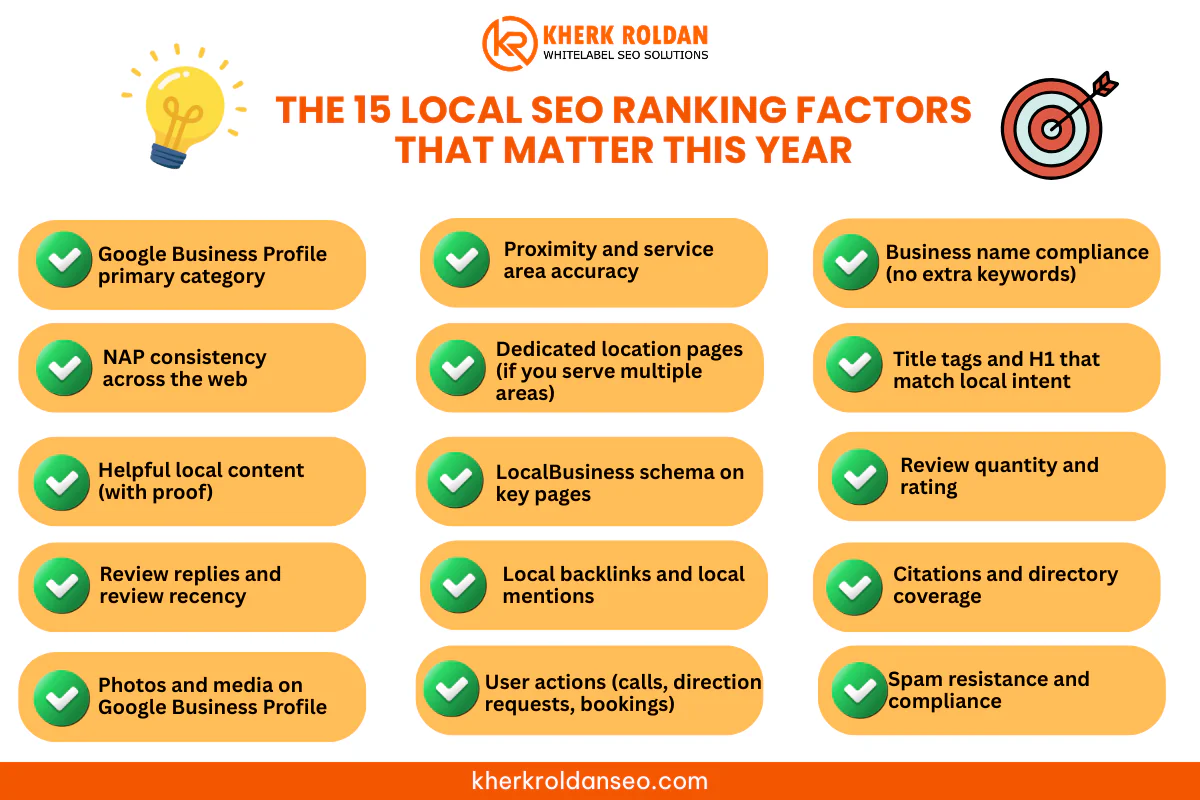
The 15 local SEO ranking factors that matter this year
1) Google Business Profile primary category
Your primary category is one of the strongest relevance signals. If you choose “Contractor” but you are really a “Window Tinting Service,” you will fight an uphill battle.
Do this:
- Pick the closest match as the primary category.
- Add a few secondary categories only if they truly apply.
2) Proximity and service area accuracy
Distance is real. You cannot “SEO” your way past being far away for map results.
But you can still win by setting correct service areas and building pages for the areas you serve.
Do this:
- For a storefront, show your real address.
- For a service-area business, set the service areas correctly and avoid fake locations.
3) Business name compliance (no extra keywords)
Adding extra keywords to the business name can cause suspensions or ranking drops. It also makes your listing look spammy.
Do this:
- Use the real-world business name as used on signage, invoices, and legal docs.
- Put services and keywords in the right places (services, description, pages), not the name.
4) NAP consistency across the web
NAP means Name, Address, Phone. When this data is inconsistent, trust drops and rankings can wobble.
Do this:
- Keep one “source of truth” file for your NAP.
- Fix top listings first (Google, Facebook, key directories, industry sites).
5) Dedicated location pages (if you serve multiple areas)
If you serve multiple cities, one generic page usually is not enough.
Do this:
- Create one strong page per location.
- Add local proof: photos, staff, directions, service boundaries, and real FAQs.
6) Title tags and H1 that match local intent
Local pages should clearly state the service and the place.
Do this:
- Use a simple pattern: Service + City (example: “AC Repair in Quezon City”).
- Keep it natural. Do not list 10 cities in one title.
7) Helpful local content (with proof)
In 2025, “thin” pages struggle. Add proof that you actually serve the area.
Do this:
- Add before-and-after photos, project notes, pricing ranges, and common local issues.
- Add short answers to “near me” questions.
Mini example:
A small dental clinic adds a “New Patients” page, pricing ranges, insurance list, and a clear booking flow. Calls go up because the page removes doubt.
8) LocalBusiness schema on key pages
Schema helps search engines understand your business details.
Do this:
- Add LocalBusiness (or a more specific type) on your homepage and location pages.
- Include NAP, hours, geo, and sameAs links (social profiles).
9) Review quantity and rating
Reviews are not only about stars. They are about trust. BrightLocal reported that 71% of consumers would not consider a business with an average rating below 3 stars.
Do this:
- Ask every happy customer, every week.
- Make it easy: one link, one simple message, one reminder.
10) Review replies and review recency
Fresh reviews and thoughtful replies show active customer care.
Do this:
- Reply to all reviews weekly.
- Mention the service naturally in the reply (example: “Thanks for trusting us for your ceramic tint”).
11) Local backlinks and local mentions
Prominence is partly earned by real-world signals online.
Do this:
- Get links from local chambers, suppliers, local news, local event pages, and community partners.
- Avoid shady link farms.
12) Citations and directory coverage
Citations still matter for many industries, especially when competition is tight.
Do this:
- Fix duplicates and wrong phone numbers.
- Focus on quality directories and niche sites first.
13) Photos and media on Google Business Profile
Real photos can lift trust fast. They also show activity.
Do this:
- Add new photos monthly: storefront, team, work, service in action.
- Use clear names and keep them real (no stock-only profiles).
14) User actions (calls, direction requests, bookings)
Make it easy for someone to take the next step in seconds.
Do this:
- Put click-to-call and booking buttons above the fold.
- Make address and service area clear.
- Keep forms short.
15) Spam resistance and compliance
Local SERPs can be messy. Fake listings and keyword-stuffed profiles can crowd you out. That is why spam reporting and staying clean matters.
Do this:
- Report obvious spam competitors.
- Keep your own listing within guidelines to avoid suspensions.
A simple 30-day plan to improve SEO rankings
If “how to improve seo rankings” is the main goal, start here.
Week 1: Fix the foundation
- Confirm primary category and services.
- Fix NAP on your top listings.
- Add a clear call, booking, and directions path.
Week 2: Build strong local pages
- Improve your main service page and one location page.
- Add local photos, proof, and FAQs.
- Add LocalBusiness schema.
Week 3: Reviews and trust
- Start a review request routine (every happy customer).
- Reply to every review.
- Add testimonials to your website pages.
Week 4: Prominence
- Reach out to local partners for mentions and links.
- Clean up citations and duplicates.
- Add fresh GBP photos and a weekly post.
FAQs
What are the top SEO ranking factors?
The biggest groups are relevance, distance, and prominence. Within those, categories, reviews, strong local pages, NAP consistency, and local links usually make the fastest difference.
How long does it take to improve SEO rankings?
Many businesses see early movement in 4–8 weeks after fixing GBP, reviews, and key pages. Competitive areas can take longer, especially if trust signals are weak.
Do citations still matter in 2025?
Yes, especially for service businesses and multi-location brands. Citations help consistency and trust when they are accurate and not duplicated.
Do more reviews always mean better rankings?
Not always, but reviews strongly impact trust and conversions. One key point: many consumers will not choose a business below 3 stars. Focus on quality service, then ask consistently.
Can a service-area business rank without an address showing?
Yes, but proximity is still a factor. Strong service-area pages, reviews, and prominence signals help you compete.
What is the biggest mistake that hurts local SEO ranking?
Inconsistent business info and a weak Google Business Profile setup. A close second is thin pages that do not prove real local service.
Conclusion
If local visibility is the goal, a clear plan beats guessing. Kherk Roldan Advanced Digital Solutions has delivered 50,371+ SEO projects, and the same structured approach can be applied to your local market.
Book a FREE SEO Strategy Session and get a step-by-step action plan based on your Google Business Profile, citations, reviews, and local pages.