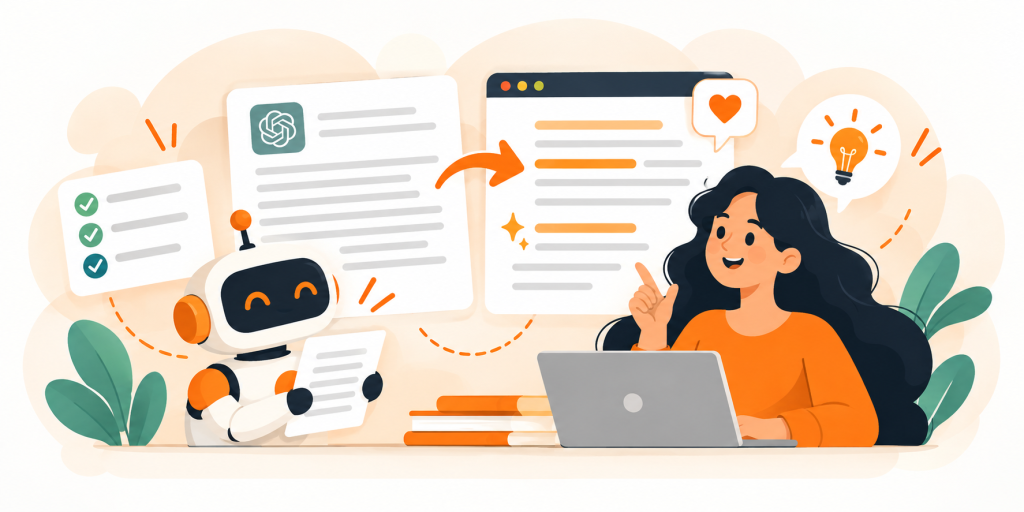
AI writing tools can create endless words in seconds — but most still struggle to sound human. Readers notice when something feels robotic, and that disconnect can quietly erode trust.
To truly connect, your AI-assisted content must blend machine efficiency with human depth, personality, and empathy. Let’s explore how to make your AI-generated content sound more human — and more persuasive.
Why Humanizing AI Content Matters in 2025
AI isn’t replacing human creativity — it’s amplifying it. But when text feels cold or formulaic, readers disengage fast. In a 2024 HubSpot survey, 72% of consumers said they can “easily tell” when content sounds AI-written, and 68% trust brands less when it happens.
The reason is simple: humans connect through emotion, tone, and authentic experience. AI can mimic words, but it can’t replicate a lived perspective.
Humanized AI content impacts key metrics:
- Higher read time and scroll depth
- More comments, shares, and backlinks
- Stronger brand perception and trust
- Better conversion and retention rates
When your audience feels your brand “gets” them, even algorithmic content becomes personal.
Common Signs of Robotic AI Writing
You’ve seen it before — articles that feel… off. Perfect grammar, logical structure, but zero soul. Here’s what gives AI text away:

When every paragraph feels like it was written by the same “voice,” readers disconnect.
Step-by-Step Guide: Making AI Content Sound More Human
1. Add Real Experiences and Insights
AI writes from data — you write from experience.
Take the base AI draft and inject moments that only you or your team can share:
- Tell a quick story about a campaign that failed and what you learned.
- Mention a client challenge that inspired a process change.
- Reference emotions: confusion, excitement, doubt — real human states.
Even one paragraph of genuine experience transforms bland AI output into believable expertise.
Example:
Instead of: “Customer retention is essential for business growth.”
Try: “When one of our e-commerce clients lost 20% of repeat buyers, we realized retention isn’t about discounts — it’s about recognition.”
2. Write Like You Speak
The easiest way to humanize AI writing? Read it aloud.
If it doesn’t sound like something you’d actually say, change it. Use conversational structure:
- Contractions (“you’ll,” “we’re,” “they’re”)
- Occasional rhetorical questions (“Sound familiar?”)
- Transitions like “here’s the thing,” “in short,” or “let’s be honest.”
This simple tweak adds rhythm, warmth, and believability.
3. Vary Sentence Length and Structure
AI often produces uniform paragraphs: long, evenly paced, predictable. Humans don’t write that way.
Try alternating between:
- Short punchy lines for impact.
- Longer reflective sentences for storytelling or detail.
This cadence keeps readers engaged and mirrors the way real people think and speak.
4. Incorporate Storytelling and Emotion
Humans connect through stories — not summaries.
Whenever possible, frame your content around:
- A challenge → solution → result pattern.
- Before-and-after comparisons.
- Relatable scenarios readers can see themselves in.
Even technical content benefits from narrative flow. The brain remembers emotions longer than facts.
Example: “Last year, one of our agency partners was ready to quit content marketing. We helped rebuild their blog strategy — and six months later, it became their top sales channel.”
That’s far more memorable than a generic claim about “content performance improvement.”
5. Edit for Context and Cultural Nuance
AI struggles with subtlety — jokes, idioms, or cultural references often misfire.
Always review for:
- Cultural tone: Does this phrase fit your audience’s language style?
- Local context: Does it reference situations your market understands?
- Empathy gaps: Does it sound dismissive, overly confident, or insensitive?
For example, content for Filipino readers might include shared humor or relatable expressions like “Para sa mga nagsisimula pa lang…” — small touches that instantly make it feel real.
6. Use Emotion Intentionally
AI avoids strong emotion by default, but emotion builds connection. Don’t be afraid to:
- Express excitement or frustration.
- Use sensory language (“felt like hitting a wall,” “the relief was instant”).
- Show vulnerability (“We almost gave up on that campaign…”).
Emotion isn’t manipulation — it’s empathy. Readers respond to authenticity, not perfection.
7. Edit for Rhythm and Flow
Before publishing, read your AI-assisted piece out loud:
- Does it have a natural rhythm?
- Are the pauses where a human would breathe?
- Does each paragraph lead smoothly into the next?
If it sounds robotic, rewrite transitions. Humans use variety, hesitation, and emphasis — AI doesn’t.
8. Blend AI Strengths with Human Oversight
AI can draft, summarize, or outline. You should handle:
- Tone refinement
- Context accuracy
- Voice consistency
- Final emotional polish
The best content workflows in 2025 are hybrid: AI builds efficiency; humans build connection.
Tools and Techniques to Support Humanization

Avoid relying on “AI humanizers.” They only mask the problem. The most effective way to humanize content is by letting real people add judgment, humor, and empathy.
Measuring the Success of Humanized AI Content
Humanized writing feels good — but it should also perform better. Here’s how to measure that impact:
- Average time on page: If readers stay longer, your content resonates.
- Scroll depth: Track how far users read before exiting.
- Engagement rate: Comments, reactions, and shares are signs of connection.
- Click-through rate: Authentic tone increases action.
- Conversions: Ultimately, humanized content drives business outcomes.
In one internal test, rewriting AI-generated blog posts with a conversational tone led to a 38% increase in time on page and 24% higher lead form completion rates.
The Ethics of Transparency
Readers value honesty. If your content was assisted by AI, transparency builds trust — as long as the human role is clear.
Consider adding a note such as:
“This article was drafted with AI assistance and refined by our content team.”
It’s subtle, honest, and reinforces that humans are still in charge of quality.
FAQ
- Why does AI-generated content often sound robotic?
Because it lacks real emotional understanding, uses repetitive patterns, and avoids personal voice or perspective. - Can AI content rank on Google if it sounds too mechanical?
It can — but engagement metrics (like dwell time) may drop. Google increasingly favors content that demonstrates experience and authenticity. - Should I disclose AI use in content?
Yes, when appropriate. Transparency builds credibility, especially for expert-driven brands. - What’s the fastest way to humanize AI writing?
Add short anecdotes, conversational transitions, and emotional language during editing.
5. How can I maintain consistency across AI-assisted content?
Use a brand voice guide outlining tone, vocabulary, and empathy standards your editors must apply.
Conclusion: Machines Write, Humans Connect
AI can produce words — but humans give them meaning. The brands that thrive in 2025 will be those that combine automation with empathy.
At Kherk Roldan White Label SEO Solutions, we help agencies and businesses create content that sounds real, reads naturally, and drives results.
If you want to audit or refine your AI-generated content for human tone and engagement, schedule a strategy session today. Let’s turn machine-made drafts into stories that connect.