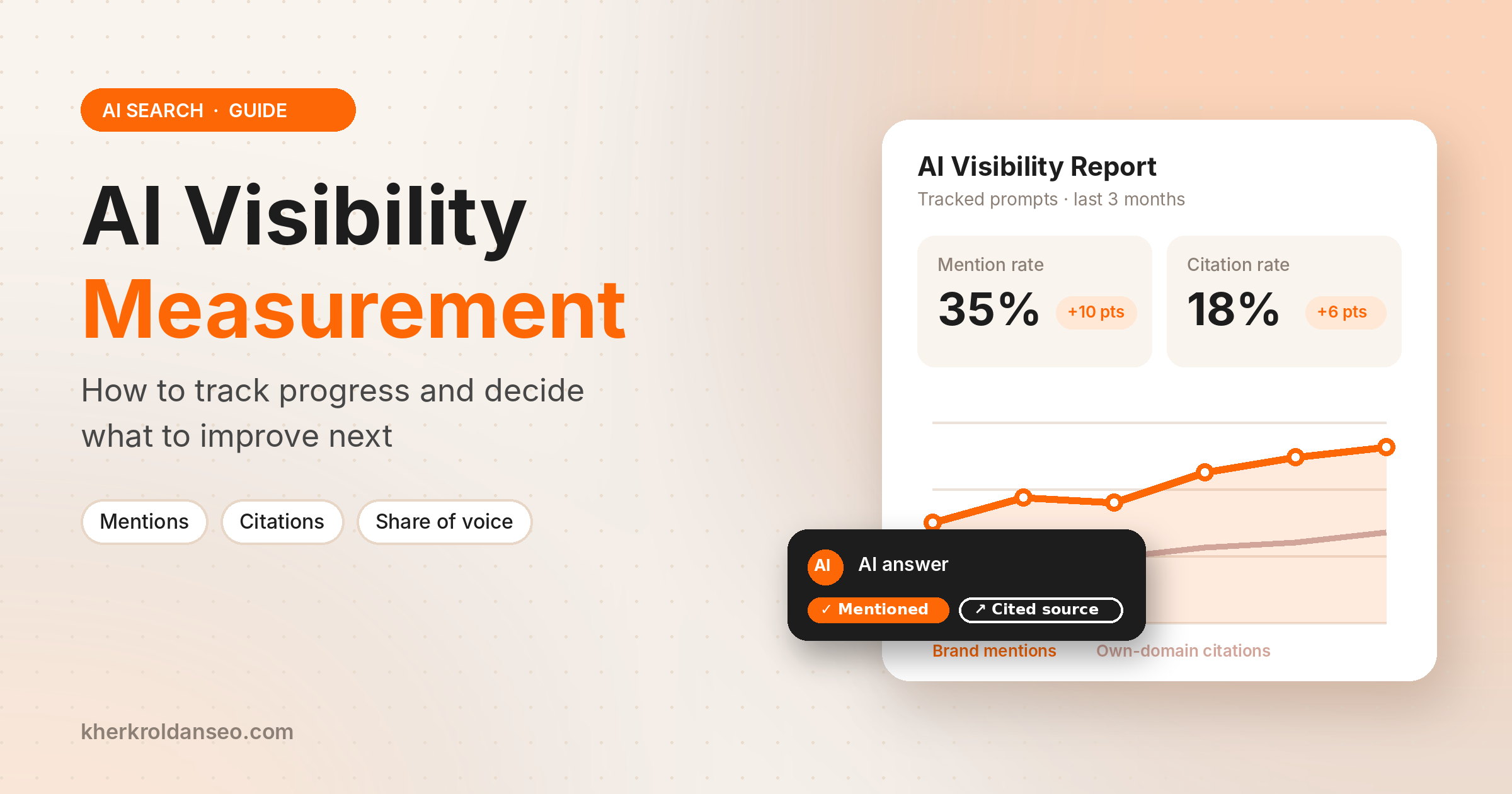
Your brand might already show up in ChatGPT, Perplexity, or Google AI Overviews. But without proper AI visibility measurement, you can’t tell whether that presence is growing, shrinking, or doing anything for your business.
One screenshot of an AI answer proves very little. AI responses change from one session to the next, competitors appear and disappear, and a brand mention is not the same thing as a citation, a website visit, or a sale.
This guide shows you how to connect AI brand mentions, citations, and competitive visibility to real business outcomes. You’ll learn how to set a reliable baseline, track AI search visibility consistently, read what the numbers are telling you, and decide which optimization to work on next.
What Is AI Visibility Measurement?
AI visibility measurement is the process of tracking how often, how accurately, and in what context a brand or website appears in AI-generated answers across a fixed set of prompts and platforms, then comparing those results against competitors and over time.
It’s different from traditional rank tracking. In classic SEO, you check where a URL sits for a keyword on a results page. AI platforms don’t return a stable list of ten links. They generate an answer, and that answer may name your brand, link to your page, cite a third-party article about you, or leave you out entirely.
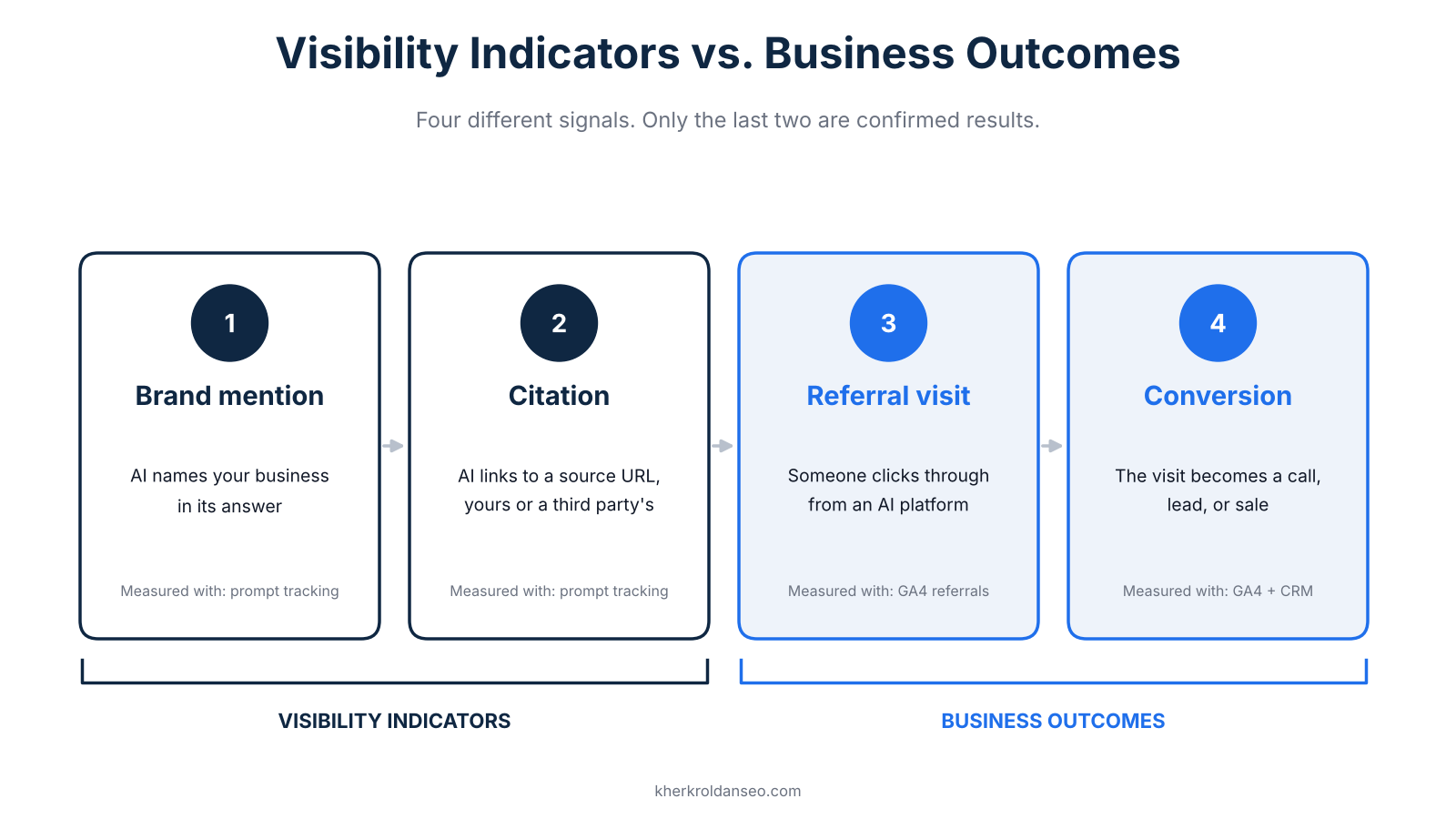
That’s why AI visibility measurement separates three things:
- Brand mentions: The AI answer names your business, with or without a link.
- Citations: The answer links to a source URL, which may be your site or an independent publisher.
- Visits: Someone actually clicks through to your website from an AI platform.
Each platform exposes different information. ChatGPT may show linked sources when it searches the web. Google AI Overviews and Google AI Mode display supporting links alongside the generated answer. Perplexity lists numbered citations with most responses. None of them provide the same metrics, so your measurement method has to account for those differences.
One AI answer can’t establish a trend. Responses vary by session, location, phrasing, and timing. Reliable measurement comes from repeating the same prompts on a schedule and looking at the pattern.
Which AI Visibility Metrics Should You Track?
The right AI visibility metrics fall into two groups: visibility indicators, which show whether AI platforms surface your brand, and business outcomes, which show whether that visibility produces visits, leads, or sales. Keep them apart in every report.
Metric | How it’s measured | Why it matters |
AI visibility score | A summary score from your tool or your own formula across tracked prompts | Gives a quick read on overall direction |
Prompt coverage | Distinct prompts with at least one brand mention ÷ distinct prompts tested | Shows how many important questions you appear for |
Brand mention rate | Sampled answers naming the brand ÷ total sampled answers | Measures how consistently AI includes you |
Own-domain citation rate | Sampled answers linking to your domain ÷ total sampled answers | Shows whether AI uses your site as a source |
AI share of voice | Your mentions ÷ mentions of you plus selected competitors | Benchmarks you against named rivals |
Description accuracy | Manual review of how AI describes your services, locations, and pricing | Catches outdated or wrong information |
AI referral traffic | Sessions from identifiable AI referrers in analytics | First confirmed business signal |
AI-referred conversions | Leads, calls, or sales from those sessions | The outcome that justifies the work |
AI Visibility Score and Prompt Coverage
An AI visibility score condenses performance across your tracked prompts into one number. It’s useful for spotting direction, but every vendor calculates it differently. A 62 in one platform isn’t comparable to a 62 in another.
Prompt coverage is simpler and easier to explain: the share of tracked prompts where your brand appeared at least once during the reporting period.
Brand Mentions and AI Citation Frequency
AI brand mentions count how often the answer names you. AI citation tracking counts how often the answer links to a source. These are different signals. An AI platform can describe your company accurately while citing a directory, a review site, or a news article instead of your own website.
AI Share of Voice and Competitor Visibility
AI share of voice compares your mentions with those of chosen competitors using identical prompts, platforms, and dates. In this guide, we use: your brand mentions ÷ total mentions of your brand and selected competitors × 100. State your formula in every report, because there’s no universal standard.
AI Referral Traffic and Conversions
Google Analytics 4 can show sessions from referrers such as chatgpt.com or perplexity.ai, plus the conversions those sessions drive. Attribution is incomplete, though. Some AI visits arrive without referrer data and land in direct traffic, and visits from Google’s AI features are generally reported within Google organic traffic rather than separated out.
Also review the accuracy of brand descriptions. A mention that gets your services or service area wrong can do more harm than no mention at all.
The key distinction: mentions, citations, and scores are visibility indicators. Referral visits and conversions are confirmed business outcomes.
How to Measure AI Visibility Step by Step
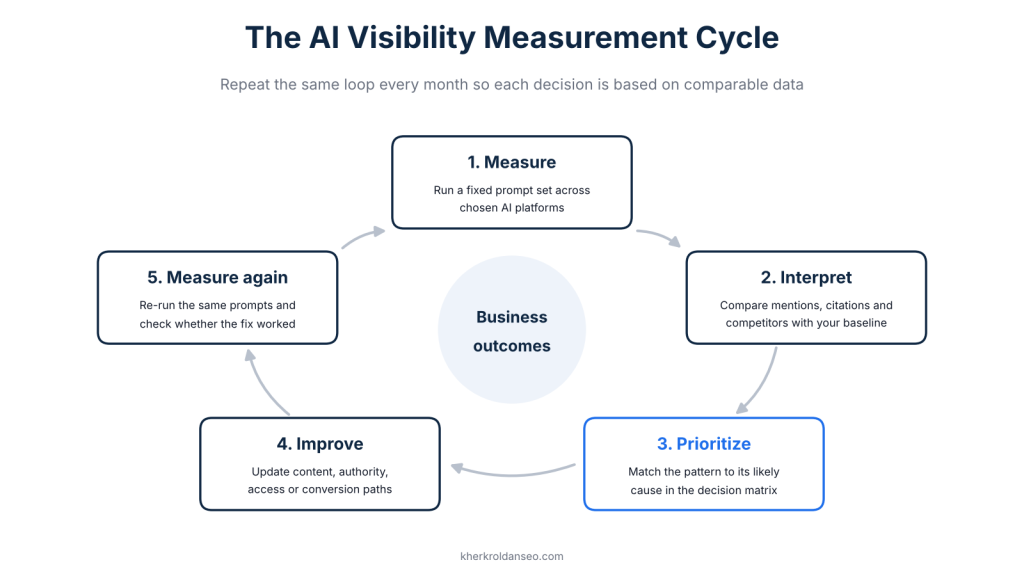
Here’s how to measure AI visibility in a way you can repeat every month and trust when it’s time to make decisions.
Step 1: Select Your AI Search Platforms
Start with the platforms your customers actually use and the ones you can measure reliably. For most U.S. businesses, that means ChatGPT, Gemini, Perplexity, and Google’s AI search experiences (AI Overviews and AI Mode). A B2B software company and a local plumber may weight these differently. Don’t track a platform just because it exists.
Step 2: Build a Consistent Set of Search Prompts
Write 20–30 prompts to start. That’s a practical starting point, not an industry standard. Group them into four categories:
- Informational: “How often should a commercial HVAC system be serviced?”
- Comparison: “Best HVAC companies in Austin for commercial buildings”
- Purchase intent: “Who offers 24/7 commercial HVAC repair in Austin?”
- Branded: “Is [Your Company] a good HVAC contractor?”
Report branded and unbranded prompts separately. Branded prompts almost always mention you, and mixing them in inflates your results.
Step 3: Establish Your Baseline
Run every prompt and record the date, platform, country or location, prompt, whether your brand appeared, any cited URL, which competitors appeared, and whether the description was accurate. Run each prompt more than once. AI answers vary, so several samples per prompt give you a truer starting point than one.
Step 4: Monitor Results Consistently
Collect data weekly when you can, and review performance monthly. Keep your core prompt set, platforms, location settings, and method stable. If you change the prompts every month, you can’t tell whether results moved because of your work or because of the new questions
Step 5: Compare Performance Against Competitors
Look at which brands appear when yours doesn’t. Open the pages AI platforms cite for those competitors. Check what questions those pages answer, what evidence they provide, and how clearly they’re structured.
Step 6: Identify the Next Optimization Priority
Translate each gap into one of four types of work: content improvements, technical investigation, authority building, or conversion improvements. The decision matrix in the next section shows how to choose.
Worked example (fictional figures for illustration only): A commercial cleaning company tracks 30 unbranded prompts on three platforms and samples each prompt twice per platform, giving 180 sampled answers. Its brand appears in 45 answers, a 25% mention rate. It appears for 11 of 30 prompts, or 37% prompt coverage. Its own domain is linked in 18 answers, a 10% citation rate. A competitor appears in 81 answers. Most of the cleaning company’s missing prompts are purchase-intent questions about specific cities, which points to a service-area content gap as the first priority.
How to Decide What to Improve Based on Your AI Visibility Results
A metric is only useful when it leads to a reasonable, testable action. Most AI visibility tracking stops at the dashboard. The real work starts when you match each pattern in the data to a likely cause and a first move.
Treat every fix below as a hypothesis to test, not a confirmed reason an AI platform chose or ignored a source. No one outside these companies can see exactly how their systems select sources.
When Your Brand Is Missing From Relevant AI Answers
Start with the basics. Does your site actually answer the question in the prompt? Check topical coverage, content relevance, and whether AI crawlers can access your key pages. Then look outward: do independent sources such as directories, review sites, or industry publications mention you? Compare your pages with competitors that appear. They often answer questions your site simply doesn’t cover.
When Competitors Receive More Mentions and Citations
Open the pages AI cites for them. Look for citation gaps, stronger supporting evidence, comparison content, original data, and broader brand authority. Understanding why your competitors rank higher can also reveal content quality, authority, and technical gaps worth investigating alongside AI visibility.
When AI Mentions Your Brand but Doesn't Cite Your Website
This usually means AI knows about you from somewhere else. Ask whether your site offers something worth citing: original evidence, clear definitions, concise explanations, and dedicated pages for each topic. Also confirm those pages are crawlable and not buried behind scripts, forms, or logins.
When AI Visibility Improves but Conversions Remain Flat
Check the intent of the prompts you’re winning. Informational visibility rarely converts right away. Review the landing pages AI visitors reach, the calls to action on those pages, and your conversion paths. Also check attribution gaps. No tracked conversion doesn’t mean no brand impact, since some AI-influenced buyers search your name later or call directly.
Observed result | What to investigate | Potential next action |
Few mentions on important unbranded prompts | Topic and content gaps | Update or create relevant content |
Competitors cited more often | Source quality and evidence gaps | Improve original research and supporting content |
Brand mentioned but not linked | Citation patterns and available source pages | Improve useful, accessible reference material |
Mentions increasing but inaccurate | Inconsistent or outdated brand descriptions | Correct owned content and relevant listings |
Citations rising but conversions flat | Landing page intent and attribution | Improve conversion pathways and tracking |
Scores fluctuate sharply | Sampling variability or changed methodology | Repeat measurements before changing strategy |
Not Sure Which SEO Improvements to Prioritize? AI visibility data can reveal opportunities, but choosing what to work on next takes a clear strategy. If your tracking reveals recurring visibility gaps and you’re unsure what to prioritize, book a strategy session with our team to discuss your SEO challenges and explore a practical growth plan.
What Tools Can Help You Track AI Search Visibility?
AI visibility tools fall into three groups, and most teams need at least two of them.
Dedicated AI visibility platforms run your prompts on a schedule and record mentions, citations, sentiment, and competitors. Examples include Semrush’s AI Visibility Toolkit, which adds brand performance, prompt research, and AI prompt tracking to its SEO suite; Profound, an enterprise platform with citation analysis, share of voice, and AI crawler analytics; Peec AI, which focuses on daily prompt tracking, citation gaps, and competitor benchmarking; and Searchable, which pairs prompt monitoring with competitor comparisons and site audits. Features and platform coverage change often, so confirm them on each vendor’s site before you buy.
Analytics tools such as Google Analytics 4 and Google Search Console measure what happens on your website. GA4 can show identifiable AI referral sessions and conversions. Search Console includes AI Overviews and AI Mode activity within overall web search data. Neither is a full AI mention tracker.
Manual tracking in a spreadsheet works for small prompt sets and gives you raw answers to review yourself.
When comparing tools, check for:
- Historical data and trend views
- Prompt-level reporting
- Access to raw AI responses
- Platform coverage that matches your audience
- Competitor comparisons
- Geographic and location filtering
- A clearly explained scoring methodology
How to Build an AI Visibility Reporting Dashboard
Good AI visibility reporting turns raw prompt data into a one-page monthly view that shows what changed, why it matters, and what happens next.
Include Your Baseline, Current Results, and Competitor Comparison
Show the same metrics in every period so stakeholders can compare like for like. Separate results by platform, because a gain in Perplexity and a drop in Google AI Overviews can cancel out in a blended number. Report branded and unbranded prompts separately, and put competitor share of voice next to your own figures.
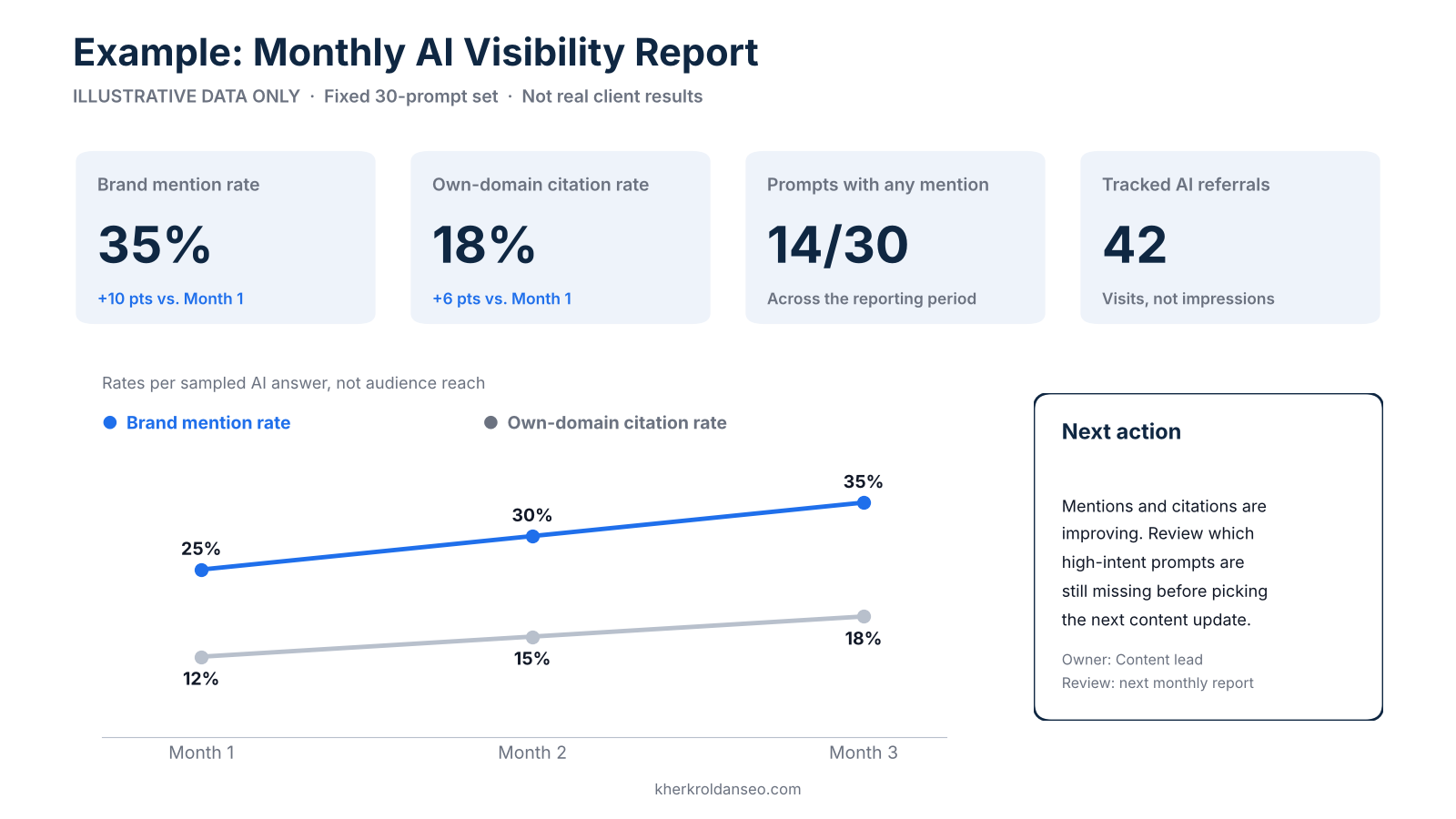
In this fictional example, the brand also appeared for 14 of 30 tracked prompts and recorded 42 identifiable AI referral visits. Those are visits, not impressions. Sample interpretation: mentions and citations are improving, but the team should check which high-intent prompts are still missing before choosing its next content update.
Use consistent formulas every month:
- Mention rate = sampled answers containing the brand ÷ total sampled answers × 100
- Own-domain citation rate = sampled answers linking to the brand’s domain ÷ total sampled answers × 100
- Prompt coverage = distinct prompts producing at least one brand mention ÷ distinct prompts tested × 100
Keep denominators, sample sizes, and definitions the same across reporting periods.
Add Actions, Owners, and Review Dates
A dashboard that only reports numbers gets ignored. Add a short action block under the metrics:
Report element | Example |
What changed | Unbranded mention rate rose; purchase-intent coverage stayed flat |
Likely implication | Informational content is being picked up; service pages are not |
Planned improvement | Expand three city service pages with pricing and FAQs |
Owner | Content lead |
Review date | Next monthly report |
Don’t combine different metrics into one arbitrary success score. Mentions, citations, and conversions measure different things, and blending them hides which one actually moved.
A 30/60/90-Day Plan for Improving AI Visibility
This plan gives you a structure to improve AI visibility in focused stages. Treat these as review periods, not guaranteed timelines for more citations.
Days 1–30: Measure and Audit
- Choose your platforms and finalize your prompt set.
- Record baselines for mentions, citations, prompt coverage, and description accuracy.
- Identify the competitors that appear most often and the pages AI cites for them.
- Verify your measurement quality by repeating samples and checking for inconsistent results.
Days 31–60: Improve Content and Authority
- Update the priority pages tied to your biggest gaps.
- Add original evidence, clear definitions, and direct answers.
- Fill topical gaps with new pages where needed.
- Confirm AI crawlers and search engines can access key pages.
- Pursue legitimate third-party visibility, such as industry publications, relevant directories, and genuine reviews.
Days 61–90: Reassess and Refine
- Compare results against your baseline using the same prompts and method.
- Review AI referral traffic and conversions alongside visibility metrics.
- Document what’s uncertain, including changes that may come from sampling variation.
- Select the next set of improvements and start the cycle again.
Turn AI Visibility Insights Into Your Next SEO Strategy
Effective AI visibility measurement comes down to three habits: monitor consistently, interpret carefully, and act on the clearest priority. Measure, interpret, prioritize, improve, then measure again.
Tracking mentions and citations is only the beginning. The harder part is deciding where your time and resources will make the biggest difference.
That’s where Kherk Roldan SEO can help. We support agencies with white-label SEO fulfillment and growth support, built on 16 years of hands-on SEO experience. If you want help evaluating SEO gaps and building an actionable growth plan for your clients, [book your free strategy session](LINK: Strategy Session page) with our team.
Frequently Asked Questions About AI Visibility Measurement
How do you measure AI visibility?
You measure AI visibility by running a fixed set of relevant prompts across chosen AI platforms on a regular schedule, then recording brand mentions, citations to your website, prompt coverage, competitor appearances, and description accuracy. Compare each period against your baseline and pair the results with AI referral traffic and conversions from your analytics.
What is a good AI visibility score?
There’s no universally reliable benchmark for a good AI visibility score. Scores depend on each tool’s formula, the prompts you track, the platforms included, sample size, and how competitive your industry is. The most useful comparison is your own score against your baseline and against selected competitors measured the same way.
How often should you track AI visibility?
Weekly data collection with monthly interpretation is a practical starting cadence for most businesses. Weekly samples smooth out answer variability, while monthly reviews give changes time to show. Increase frequency when you have a large prompt set, a major launch, or a business reason to watch results closely.
Can Google Analytics track AI search visibility?
Google Analytics 4 can identify some AI referral traffic, such as visits from ChatGPT or Perplexity, and the conversions those visits produce. It can’t measure brand mentions, citations, or AI answers that never generate a click. Some AI visits also arrive without referrer data, so GA4 works best alongside a dedicated tracking method.
How long does it take to improve AI search visibility?
There’s no fixed timeline for improving AI search visibility. Results depend on competition, how quickly AI platforms discover your updated content, content quality, third-party authority, and which platforms you measure. A 90-day review cycle gives you enough data to judge direction, but it isn’t a guarantee of results within that window.