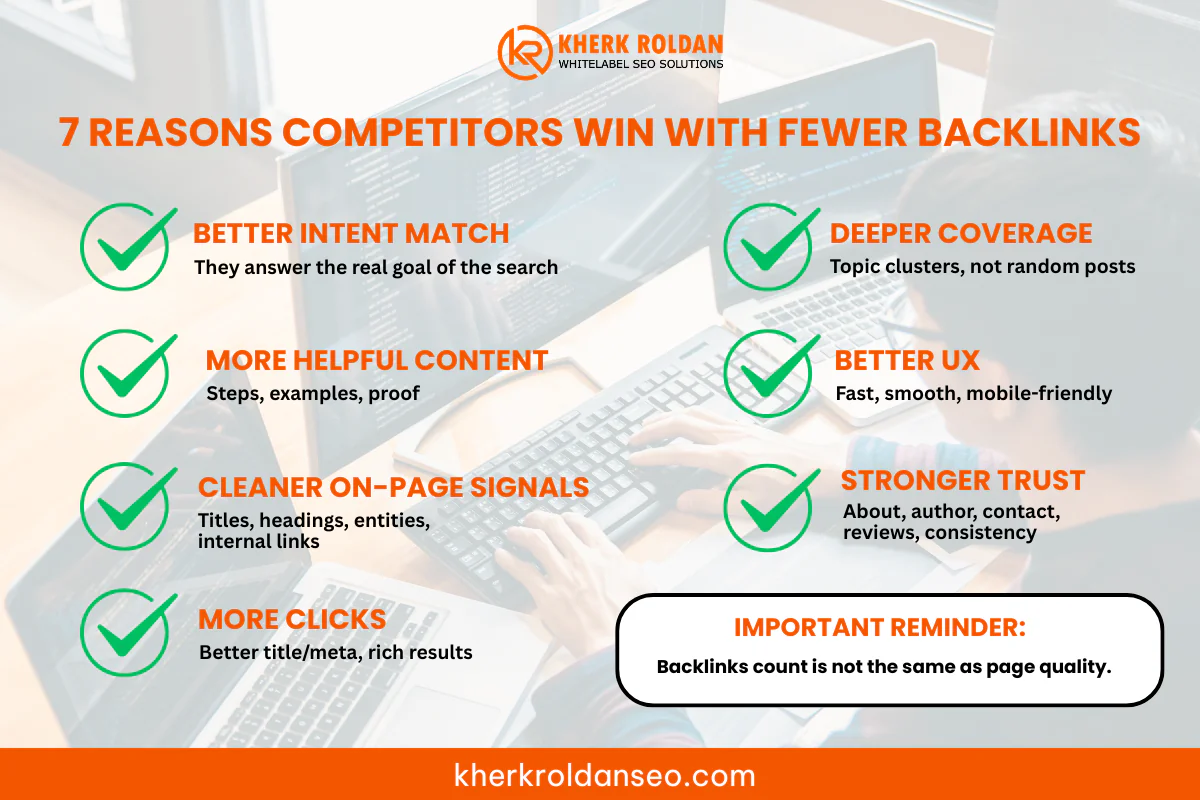
If competitors rank higher than you, it is rarely “just backlinks.” Links still matter, but Google also rewards the page that best matches the search, answers it clearly, and feels trustworthy.
This guide shows what to check, why it works, and what to fix first.
Competitors rank higher because Google ranks pages, not link counts
A backlink count is a single signal. Google uses many signals and systems to show helpful results. The page that wins usually does more of these things well: relevance, usefulness, clarity, speed, trust, and proof.
Here is the key idea:
- Backlinks can open the door
- On-page relevance + user experience + trust keeps the page in the top spots
So if a competitor has fewer backlinks, but their page is better aligned with what people want, they can still beat you.
7 Real Reasons a Competitor Outranks You with Fewer Backlinks
1) Their page matches the intent better
Intent is the “why” behind the search.
Example:
- Search: “best payroll software for small business.”
- Intent: comparison + short list + pros/cons + pricing
If your page is a long story with no comparison, it loses.
Quick check
- Look at the top 5 results.
- Write down what format keeps showing up (list, guide, tool page, review, local map pack).
- If your page is a different format, that is often the first gap.
2) They cover the topic deeper (topical authority)
Many sites publish random posts. Strong sites build topic clusters that cover the whole subject in a structured way, with strong internal linking.
Search engines can understand that “this site consistently covers this topic.”
What this looks like in real life
- One main page (pillar)
- Supporting pages that answer related questions
- Internal links connecting them in a clean structure
Simple action
- Build 1 pillar page and 6–12 supporting pages for one money topic.
- Link them together using natural anchor text.
3) Their content is more “helpful” (not written for rankings)
Google is clear: ranking systems aim to show helpful, reliable, people-first content. Helpful content usually has:
- Clear steps
- Examples
- Screenshots or real proof
- A straight answer near the top
- Clean structure that is easy to skim
If your competitor’s page gives the exact answer faster, that alone can win.
4) Their on-page signals are cleaner (titles, headings, entities, internal links)
A page can have great writing but still “look unclear” to search engines.
On-page items that often decide competitor rankings
- The title tag includes the main intent and benefit
- H1 matches the query theme
- H2s cover subtopics people expect
- Related terms appear naturally (not stuffed)
- Internal links point to supporting pages
- Images have descriptive file names and alt text
Mini test
If someone skims only your headings, do they still get the full story? If not, tighten your structure.
5) They win on user experience (speed and responsiveness)
In 2024, INP became part of Core Web Vitals, replacing FID, and it measures how responsive a page feels when someone clicks and interacts with it.
If your competitor’s site feels smoother (especially on mobile), they can keep users longer, reduce pogo-sticking, and earn better engagement signals.
What to check
- Mobile page responsiveness
- Heavy scripts and popups
- Large images and slow sliders
- Layout shifts (page jumping while loading)
6) They have stronger trust signals (even without more links)
Trust is not only about backlinks. Trust also comes from:
- Clear “About” info
- Real author profiles
- Review proof and case studies
- Visible contact details
- Consistent business information online (for local services)
If two pages are close, the one that “feels safer” often wins.
7) They get more clicks because their snippet looks better
Even small ranking jumps can significantly increase clicks. Backlinko found that moving up one position can increase relative CTR by 32.3% on average (their large SERP analysis).
That means a competitor can pull ahead just by:
- a clearer title
- a better meta description
- stronger “why click this” wording
- rich results (FAQ, review stars where relevant)
And in 2025, AI-driven SERP layouts can reduce traditional clicks on some queries, so winning the click that still exists matters even more.
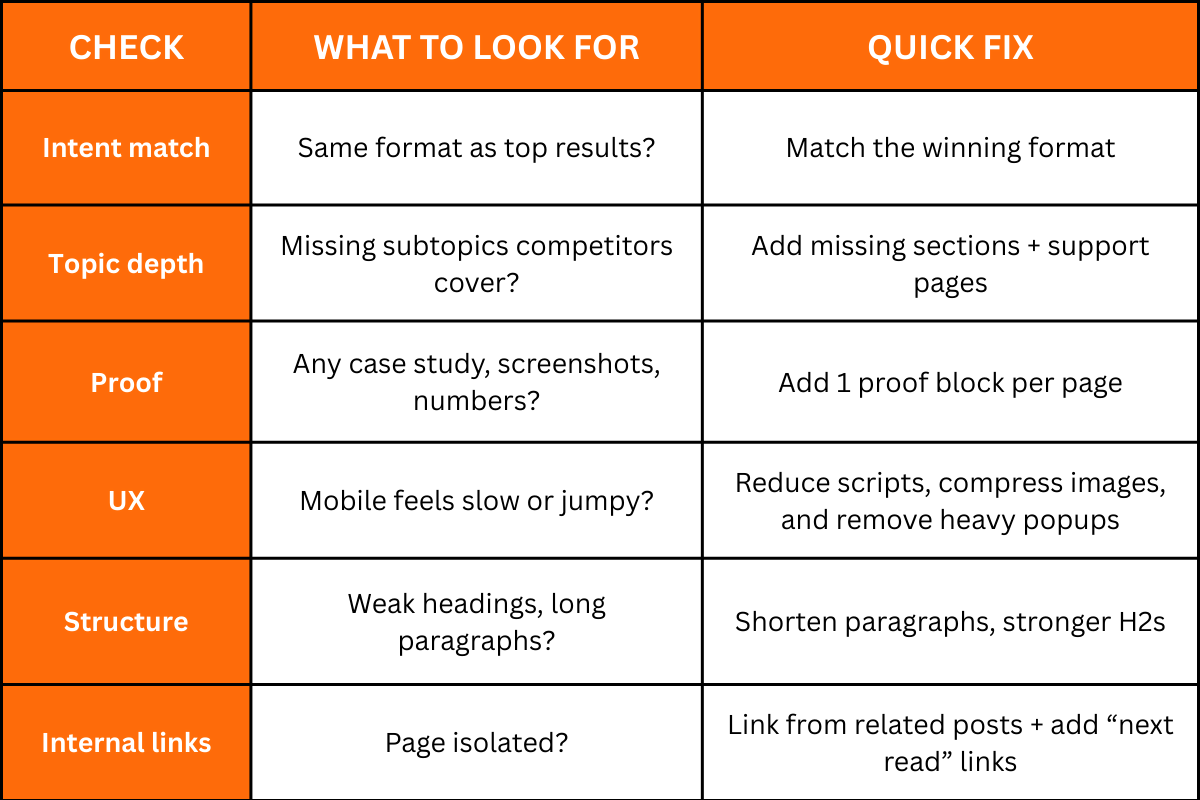
A practical competitor ranking checklist (use this before building more links)
Use this table on your top 3 money pages.
2026 realities: competitor rankings are tied to visibility, not just position
Two changes matter a lot right now:
AI Overviews change where attention goes
AI Overviews can appear for a meaningful share of queries, especially informational ones, and they can reduce clicks to standard results on some searches.
What to do about it:
- Add “direct answer” sections near the top
- Use clear subheadings that mirror common questions
- Add unique examples and proof that AI summaries cannot replace
Topic clusters beat one-off blog posts
Topical authority is not a buzzword. It is a practical way to beat competitors with fewer links by becoming the best resource on one topic.
A quick example (case-style) of why fewer backlinks still wins
Picture two pages targeting “competitor rank higher.”
Page A (yours)
- 1,200 words
- General tips
- No examples
- Slow mobile experience
- No supporting pages
Page B (competitor)
- 1,800–2,200 words
- Clear checklist + table
- FAQ answers
- Links to 8 supporting pages (clusters)
- Fast mobile, clean layout
- Proof screenshots (Search Console, before/after)
Even if Page A has more backlinks, Page B yields better search results. That is why competitor rankings can look “unfair” when you only count links.
FAQ: competitor ranking and competitors' rank questions
Why do competitors rank higher with fewer backlinks?
Because backlinks are only one part of ranking. Better intent match, stronger topic coverage, clearer structure, faster mobile experience, and stronger trust signals can beat raw link count.
What matters more than backlinks for SEO competitor ranking?
Usually: intent match, content usefulness, topical authority, internal linking, and user experience (including responsiveness like INP).
How can competitor ranking be checked properly?
Track:
- keyword positions for you and the competitor
- which page ranks (not just the domain)
- what sections and subtopics appear on the ranking page
- how fast and mobile-friendly the page feels
How do you find what keywords a competitor ranks for?
Use a keyword tool to pull competitor rankings, then group keywords by intent. Map them to pages so you can see what you are missing (content gaps and page gaps).
How long does it take to outrank a competitor?
It depends on the gap. A clear on-page, content, and internal linking fix can move faster than link building alone, but in competitive spaces, it can take weeks to months. Consistency wins.
Are AI Overviews affecting competitor rankings?
Rankings still matter, but AI Overviews can reduce the number of clicks on some informational searches. That makes strong “answer-first” formatting, clear headings, and unique proof content more important.
Conclusion
If competitors rank higher even with fewer backlinks, the fastest win usually comes from fixing what the page says, how it is structured, and how it feels on mobile. Links can help, but they should support a page that already deserves to rank.
If you want a clear plan that shows exactly why competitor rankings beat yours and what to do in order, check out the Full SEO Services, Technical SEO Services, or SEO Coaching on Kherk Roldan Advanced Digital Solutions.