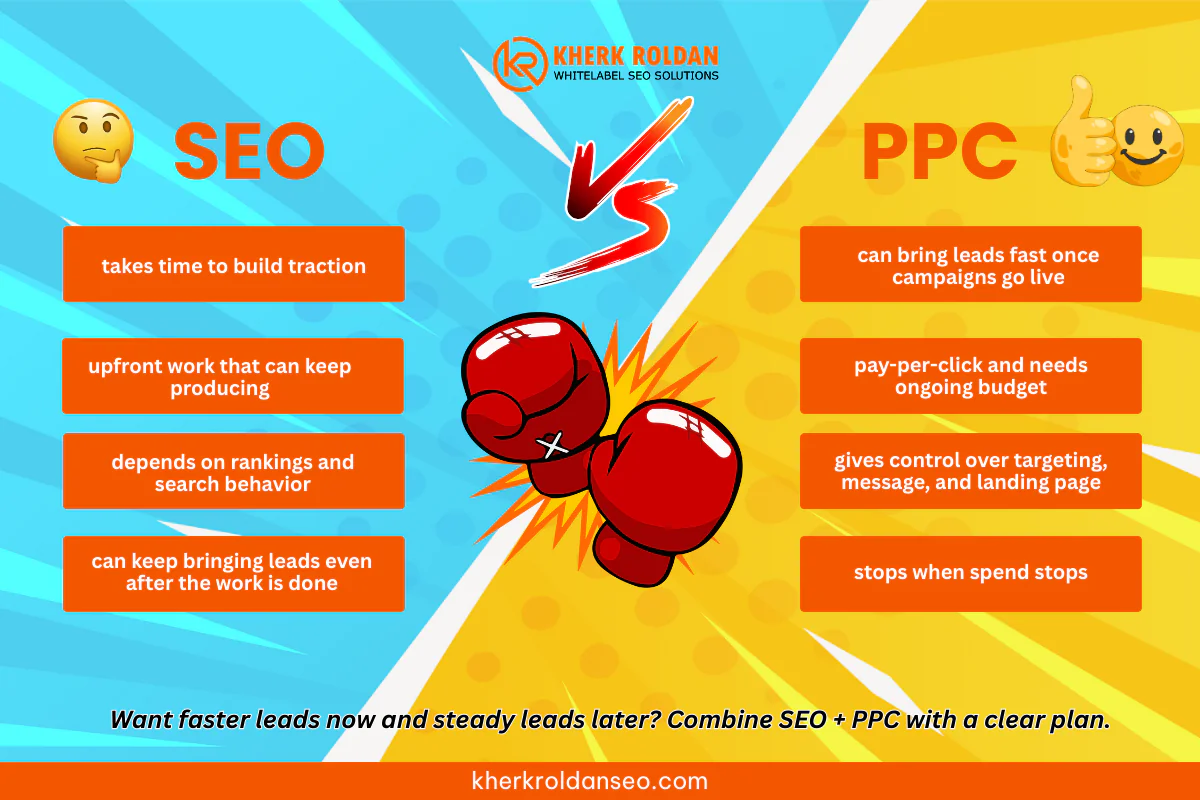
You want more leads, more calls, and more sales from Google. The hard part is choosing between SEO vs PPC. One takes time but can compound. The other is fast but stops the moment the spend stops. This guide shows when to use each, and how to combine both without wasting budget.
SEO vs PPC: What each one really does
What SEO does
SEO helps your pages show up in the non-paid results when someone searches. It is built on:
- Useful pages that match search intent
- Strong site structure and technical health
- Trust signals like reviews, mentions, and links
- Local signals if you serve a city or area
The win: SEO can keep bringing leads even when you pause spending.
What PPC does
PPC (Pay-Per-Click) places your ad in the sponsored results. You pay when someone clicks. The win: you can show up today, target high-intent keywords, and control the offer and landing page.
Google’s own guidance frames this as SEO and PPC, not a strict either-or.
PPC vs SEO: Key differences that change the decision
Here is a simple comparison you can use before spending a single peso or dollar.
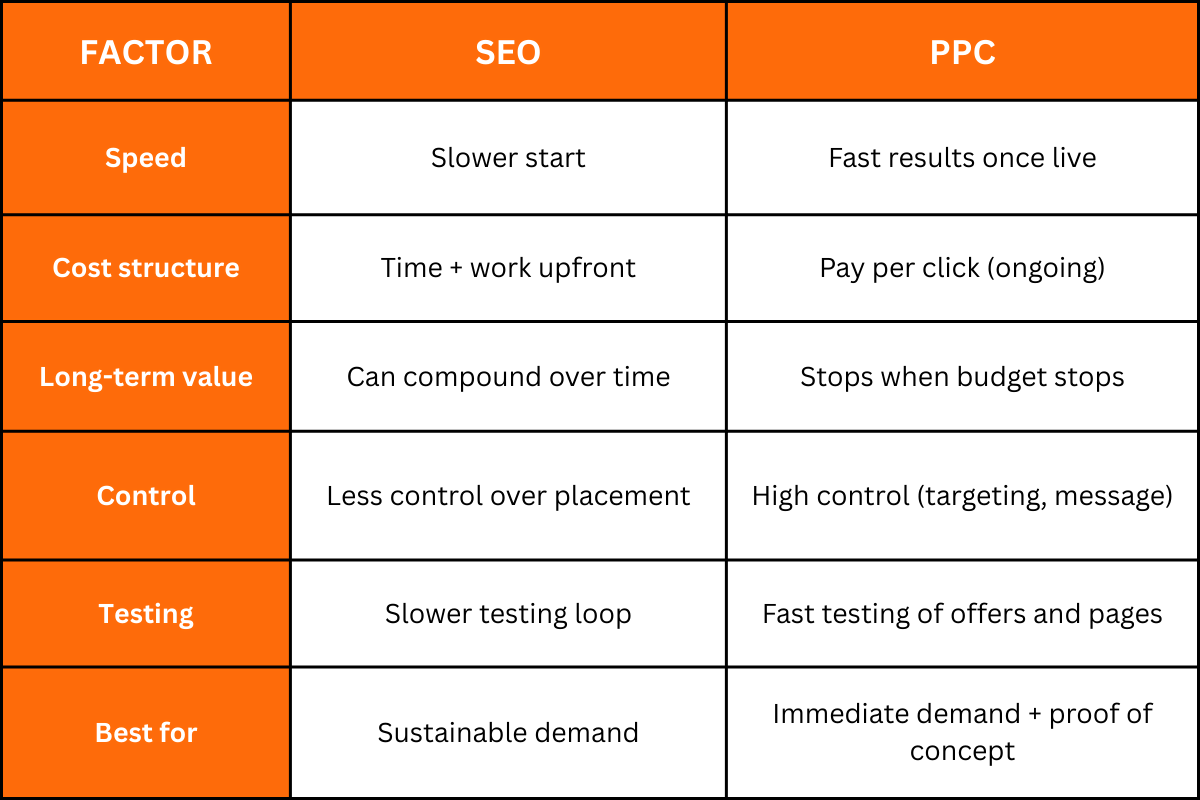
One practical detail: average CPC changes by market and industry, but benchmark reports still show paid clicks can be costly. WordStream’s Google Ads benchmarks reported an overall average CPC of $4.66 (Search) in its latest benchmark set.
SEO vs PPC: Which is better?
The honest answer is: it depends on your goal and timeline. The better question is: what mix fits your business right now? (This is also how many industry guides frame it today.)
Use this quick rule:
- Need leads this week? PPC first.
- Need lower cost leads over time? SEO foundation first.
- Need both short-term and long-term? Combine them.
When to use SEO
1) Your service has steady search demand
If people search your service every day (example: “dentist near me”, “aircon cleaning”, “gym near me”), SEO becomes a long-term asset.
2) You want lower dependency on ad spend
Paid traffic is rented. Organic visibility can stick around if your pages stay relevant and trusted.
3) Your business relies on trust and comparison
If buyers compare options, read reviews, and research, SEO helps you show up across:
- Informational searches (top of funnel)
- Comparison searches (mid funnel)
- “Near me” and branded searches (bottom funnel)
4) You serve a local area
If your business is in the Philippines or targets specific cities, local SEO can bring calls from “near me” searches and map results. Pair that with a strong profile and consistent business info.
When to use PPC
1) You need fast lead flow
Launching a new offer, filling a calendar, pushing a limited promo, or testing a new market are classic PPC use cases.
2) You want to test what converts before writing 20 pages
PPC is the fastest way to test:
- Which offer angle gets clicks
- Which landing page converts
- Which keywords bring buyers, not just visitors
3) You have high-margin services
If one customer is worth a lot (example: clinics, home services, B2B retainers), PPC can be profitable even with higher CPC.
4) You want to protect branded searches
When competitors bid on your brand name, a branded search campaign can protect your space.
How to combine SEO and PPC (the smart mix)
This is where most businesses win. SEO builds the base. PPC gives speed and testing.
The “bridge strategy” (simple and effective)
- Run PPC for high-intent keywords now
Focus on “buy now” terms and service terms with clear intent. - Use PPC data to guide SEO priorities
Look at:- Keywords with strong conversion rate
- Ads with best click-through rate
- Landing page sections people respond to
- Build SEO pages around proven winners
Create:- Service pages
- Location pages (if local)
- Comparison pages (when relevant)
- Retarget visitors from SEO with paid ads
SEO brings visitors. Retargeting brings them back to book.
Search Engine Land also points to using both channels together and deciding based on cost, speed, and long-term value.
2026 realities that affect SEO vs. PPC decisions
1) AI answers can reduce clicks
Search is giving more answers on the results page. That means SEO needs to win visibility with clear structure, strong brand signals, and content that satisfies intent fast.
2) AI-driven search ads are growing
New ad experiences are moving toward AI-driven formats, and forecasts show this segment rising fast
Practical takeaway: PPC testing and creative quality matter more, not less.
3) Ad budgets are still expanding
Global ad spending is forecast to pass major milestones, with digital taking a large share. Practical takeaway: competition in auctions stays real, so landing page quality and offer clarity matter.
4) Measurement pressure is higher
If tracking is messy, SEO and PPC both look “bad” on paper. Clean conversion tracking and simple lead quality rules are now required.
A practical decision framework (for your next 90 days)
If you are starting from zero visibility
- Month 1: PPC for lead flow + set up SEO basics (core pages, tracking, site fixes)
- Month 2: Publish SEO pages based on PPC winners
- Month 3: Keep PPC for the best keywords, reduce spend on weak ones, and push SEO content that supports sales
If you already have traffic but weak conversions
- Improve your top landing pages first (message, trust, proof, CTA).
- Use PPC to test headlines and offers quickly.
- Update SEO pages with what proves it converts.
If you are local and want calls
- Run PPC for “near me” and urgent service terms.
- Build local pages and strengthen your business profile for map visibility.
Mini case example (how the mix works in real life)
A service business runs PPC for “{service} near me” and “same day {service}”. Within two weeks, the highest quality leads come from three keywords and one offer angle.
Next, the website builds:
- A service page focused on that offer angle
- A pricing/FAQ section that answers the top objections seen on calls
- A local page for the best-performing area
Result: PPC keeps bringing leads fast, while SEO starts building a steady baseline that reduces total cost per lead over time.
This is the same type of “prove it with data, then build the foundation” approach used inside many Google search marketing playbooks.
FAQs
1) Is SEO better than PPC?
SEO is better for long-term visibility and lower dependency on ad spend. PPC is better for fast lead flow and quick testing. Most businesses win with a mix.
2) How long does SEO take vs PPC?
PPC can drive clicks and leads as soon as campaigns go live. SEO usually takes longer because it depends on site strength, competition, and content depth.
3) SEO or PPC which is better for small business?
If you need customers now, start with PPC while building SEO pages in parallel. If you have time and want compounding value, start SEO early and use PPC for your highest intent terms.
4) What is a good budget split between PPC vs SEO?
A common starting point is:
- 70% PPC / 30% SEO if you need fast leads
- 40% PPC / 60% SEO if you want long-term cost control
Your best split depends on margins and goals.
5) Can SEO and PPC work together?
Yes. PPC finds what converts now. SEO builds pages around those winners. Retargeting brings SEO visitors back to book.
6) Does PPC help SEO rankings?
PPC does not directly improve rankings. But PPC can help you learn which keywords, offers, and messages convert, and that can improve what you publish and how you structure pages.
Conclusion
If the goal is fast leads and fast learning, PPC is the tool. If the goal is steady visibility that keeps working, SEO is the base. The best path for most businesses is a combined plan where PPC proves what works and SEO builds long-term demand.
Ready for a clear mix that fits your budget and timeline?
Book a FREE SEO Strategy Session with Kherk Roldan Advanced Digital Solutions, and get a practical plan for seo vs ppc plus paid search that matches your goals.